Vibe Coding Versus Agentic Coding
You’ve probably heard the term by now. Maybe you’ve tried it yourself: describing what you want to an AI tool and watching functional software materialize in minutes, no programming knowledge required.
Welcome to the era of AI-assisted development, where two distinct approaches have emerged for building software with artificial intelligence. One says “forget the code exists.” The other says “own the architecture, let AI handle the typing.” Both are reshaping who gets to build software and how. This post breaks down what vibe coding and agentic coding actually are, where each shines, and where each falls short.

Where These Terms Came From
Vibe coding entered the lexicon on February 2, 2025, when AI researcher Andrej Karpathy posted a now-viral tweet describing a new way of working: you talk to an AI tool, accept whatever code it generates without reading it, paste error messages back when something breaks, and repeat. You “give in to the vibes” and “forget that the code even exists.” The tweet got over 6.5 million views. Google searches for the term surged 6,700%. Collins Dictionary named it their Word of the Year for 2025.
Agentic coding (sometimes called “agentic engineering”) emerged more gradually through 2025 as AI coding tools became more autonomous. Where vibe coding is defined by the developer stepping back from the code entirely, agentic coding keeps the developer in the architect’s seat while AI agents handle implementation, run tests, trace bugs, and iterate across entire codebases. By February 2026, Karpathy himself moved on from the term and endorsed “agentic engineering” as the term for serious professional practice. (Coverage: The New Stack, Business Insider)
What Each Looks Like in Practice
Vibe coding is remarkably simple, which is the point. You open a tool like Cursor, Replit, Bolt.new, or Lovable, describe what you want in plain language (“build me a recipe app with search and a sidebar”), and the AI generates everything. You run it, see if it works, and if something breaks, you paste the error back. You never open the code files. Some practitioners even dictate instructions by voice. The “source code” is effectively the conversation.
Agentic coding starts differently. The developer writes a structured plan defining architecture, constraints, and goals. This becomes the AI agent’s roadmap. The agent then autonomously writes code across multiple files, runs tests, analyzes failures, and iterates, but the developer reviews every significant change and maintains architectural control. Think of it less like magic and more like directing a skilled contractor: you provide blueprints, they build, you inspect the work.


The Case for Vibe Coding
Vibe coding’s greatest strength is democratization. For the first time, people who can’t write a line of code can build functional software. Non-programmers are creating personal tools, small business apps, and prototypes that previously required hiring a developer. In Y Combinator’s Winter 2025 batch, 25% of startups had codebases that were 95% AI-generated.
For experienced developers, the benefit is speed. First drafts materialize in minutes. The cost of exploring an idea drops to nearly zero. Vibe coding is exceptional for prototyping, personal projects, throwaway scripts, and anything where longevity doesn’t matter.
The Case for Agentic Coding
Agentic coding delivers professional-grade productivity without sacrificing quality. Enterprise case studies tell a compelling story: Rakuten achieved 79% faster feature delivery. TELUS saved over 500,000 hours. Individual developers report becoming more “full-stack” because AI fills knowledge gaps while humans provide oversight.
The developer’s role shifts from typing code to orchestrating AI agents, defining what gets built, reviewing how it’s built, and ensuring it meets real-world standards. Onboarding to unfamiliar codebases collapses from weeks to hours. The work that gets done isn’t just faster work, it’s work that wouldn’t have happened at all.


The Risks Are Real, and Different
Vibe coding’s risks center on what happens when nobody understands the code. Security research paints a stark picture: AI co-authored code shows significantly higher vulnerability rates. One study analyzed thousands of vibe-coded applications and found widespread exposed secrets, missing database security, and leaked personal data including medical records.
Maintainability is equally concerning. Since AI coding tools became widespread, code refactoring has dropped while duplication has quadrupled. The “vibe coding hangover” is what happens when someone inherits a vibe-coded codebase: code so tangled that rewriting from scratch is faster than debugging it.
Agentic coding’s risks are different. Cost is a primary concern, as token consumption for autonomous operations far exceeds simple chat interactions. Runaway agent behavior is documented: in one notable case, an AI agent deleted a production database despite explicit instructions not to. And there’s the expertise requirement: the developers who get the most from agentic tools tend to already be experienced engineers. The tools amplify expertise rather than replacing it. A rigorous randomized controlled trial by METR found that experienced developers were actually 19% slower when using AI coding tools, despite believing they were 20% faster.
It’s a Spectrum, Not a Binary
The emerging consensus isn’t that one approach will “win.” They represent a spectrum of human involvement in AI-assisted development, and professionals are learning to move along it depending on context.
The practical workflow taking shape: build fast with vibe coding to validate ideas, then graduate to agentic tools for production. Use vibe coding for the throwaway prototype. Use agentic coding for the system that needs to scale, stay secure, and be maintained by a team.


Making the Right Choice
Vibe coding works well when:
- You’re prototyping or exploring ideas
- The project is personal or low-stakes
- Speed matters more than longevity
- You don’t have programming experience and need a functional starting point
Agentic coding works well when:
- The code needs to be maintained, secured, and scaled
- You’re working in a team or professional context
- Reliability and security are non-negotiable
- You have (or have access to) engineering expertise to guide the process
Conclusion: Different Tools for Different Jobs
Vibe coding and agentic coding aren’t enemies. They’re different tools for different situations, and understanding when to use each one is becoming an essential skill.
Vibe coding opened the door for millions of people to build software for the first time. That’s genuinely transformative. But “functional” and “production-ready” are very different things, and the gap between them is where real problems live.
Agentic coding keeps human judgment at the center while capturing most of AI’s productivity gains. It’s more demanding, more expensive, and requires real expertise, but it produces software you can actually stand behind.
The AI tools are powerful and getting more powerful. The question isn’t which approach to choose. It’s whether you have the judgment to know which one fits the moment.
Need Help Navigating the AI Landscape?
At Coretechs Consulting, we specialize in helping businesses leverage the latest in software development. Whether you’re looking to prototype a new idea or build a robust, scalable system with agentic workflows, our expert team can guide you.
Contact us today to discuss your next project and how we can help you stay ahead of the curve.
AWS Cost Savings Ideas
Cloud hosting costs can spiral quickly, but you don’t need to be an expert to rein them in. By focusing on a few high-impact areas, you can dramatically reduce your hosting bill. Here we take a look at Amazon Web Services (AWS) hosting but these strategies are equally relevant with hosting on Microsoft Azure or other cloud hosting providers. Here are 5 proven strategies to start saving today!


Eliminate Unused Resources
One of the biggest (and easiest to fix) money drains is paying for resources you don’t use—like EC2 instances or RDS databases left running after testing. Think of it as leaving the lights on in an empty room.
Action: Regularly review your environment and shut down unused servers or databases. Even turning off a handful of test instances can save hundreds of dollars per month.
Manage and Clean Up Backups and Snapshots with AWS Backup Manager
Backups are essential, but unused snapshots and old backups often pile up unnoticed—quietly driving up costs.
Action: Use AWS Backup to automate retention policies. Define backup plans that keep what you need and automatically delete old recovery points. This keeps you protected without paying for unnecessary storage.


Right-Size Your Instances
Oversized instances are a common source of wasted spend. Running a powerful server when a smaller one would work is like renting a mansion when you only need an apartment.
Action: Use AWS Compute Optimizer for free, data-driven recommendations. For example, downsizing from db.r6g.xlarge to db.t4g.large could nearly cut your database costs in half—without impacting performance.
Leverage Savings Plans
For steady, long-term workloads, Compute Savings Plans can slash costs. By committing to a consistent hourly spend for one or three years, you’ll unlock discounts of up to 66% versus on-demand rates.
Action: Analyze your historical usage, set a stable baseline, and commit. Three-year plans usually deliver the deepest savings.


Set Budget Alerts
Mis-configurations or unexpected usage can cause bills to spike overnight. Budget alerts act as your early warning system.
Action: In the AWS Billing console, create an AWS Budget with thresholds (e.g., $500/month) and set alerts at 80% and 100%. If something unusual happens, you’ll know in time to fix it—before the bill arrives.
By consistently applying these five tactics—shutting down waste, managing backups, right-sizing, committing wisely, and monitoring spend—you’ll build a leaner, more cost-efficient AWS environment. If you need help putting any of this into practice don’t hesitate to Contact Us anytime for further guidance.
Slack AI Integration
Much of our internal team communication occurs over Slack. A few years ago we started a small project with some interns to create an AI integration with Slack. What started as a small project has quickly become a standard part of our company’s ecosystem. With the explosion of AI chat-bots, we noticed our developers were using a wide array of different platforms for their AI-assisted workflows. To save on costs and optimize our usage patterns, we decided to consolidate multiple Large Language Model (LLM) provider APIs into a single, powerful Slack bot.

We’ve found that certain models tend to perform better in a given area than others. Also, some team members have personal preferences for specific AI models. Giving our team access to the best (or favorite) tool for the job was a priority. Here’s a quick rundown of what we think about some particular models:
- GPT-4.1 is probably the best “general” model for fast responses with reliable tool calling
- o3 is the next step up from that if you need to solve a complex issue and need to reason through it
- Grok-3 is a good choice if conversational style and tone is important
- Gemini-2.5-pro excels at styling websites and creative writing (It peer reviewed this post!)
- Claude-Sonnet-3.7-thinking does great with coding and can work within quite complex projects
- Claude-Sonnet-4 is probably the most agentic model available and handles dozens of tools with ease while being as comparably fast as gpt-4.1
By integrating these and other models, our bot allows for per-user customization and model selection, ensuring developers can use the ideal AI for their specific task or personal preference.
We designed the bot to be seamless and intuitive within the Slack environment. Users can directly message the bot for private conversations or create dedicated interactive channels. To keep channels uncluttered, long bot responses are automatically posted in a thread. A particularly useful feature is “conversation branching” where replying to the bot inside a thread creates a separate conversational branch, allowing you to go on a tangent without disrupting the flow of the original discussion.
Behind the scenes, a dynamic context management system summarizes older parts of the conversation. This keeps token usage down, making interactions with the models more efficient and cost-effective.


All of these model choices, ease of use and integration within the team Slack environment gives us an edge in whatever projects we take on. Our team and our clients expect us to be pushing the limits of technology by using every available tool at our disposal, creating a force multiplier to quickly and efficiently build the most challenging software development projects.
Maryland Tech Tax Starting July 2025
Historically, the State of Maryland has only taxed the sale of physical goods as well as a handful of services such as sports equipment rental and pay per view. During the 2025 legislative session, earlier this year, they decided to start taxing less tangible items such as software development services. Rather than the 6% tax assessed on physical goods they’ve instead imposed a 3% Sales and Use Tax on Maryland-based businesses (consumers of these services) effective July 1, 2025.
The specific businesses (sellers aka vendors) subject to collecting the new tax at the 3% rate are:
- Data or Information Technology Services described under NAICS Sector 518 or 519, or Subsector 5415; and
- System Software or Application Software Publishing Services described under NAICS Subsector 5132.
- If you’re looking for more detail in determining if you, as a vendor, need to start collecting this tax from your customers, please see the NAICS guide. Please make sure to use the 2022 version lookup tool.
The key point for most vendors is the location of the customer, not the location of the vendor providing the services. So, if the customer is located in the State of Maryland then in most cases the vendor will need to collect 3% Sales and Use Tax from that customer. Here’s a more nuanced breakdown:
Vendors selling or delivering tangible personal property, digital codes, digital products, or taxable services in Maryland must register for a sales and use tax account, and are required to collect the sales and use tax on a retail sale, unless an exemption applies. Here are the three categories of vendors to consider:
- In-state vendors selling to a Maryland buyer – vendor must collect
- Out-of-state vendor with physical presence in Maryland selling to a Maryland buyer – vendor must collect
- Remote vendor (no physical presence in Maryland) selling to a Maryland buyer – vendor must collect if, during the previous calendar year or the current calendar year, the vendor meets the following criteria:
- Gross revenue from the sale of tangible personal property or taxable services delivered into Maryland exceeds $100,000, or
- Makes sales of tangible personal property or taxable services for delivery into Maryland in 200 or more separate transactions.
There are very few exemptions to this new tax but here are a few:
- Sales of cloud computing services to cybersecurity customers
- Sales to or by certain qualified vendors located in the University of Maryland’s Discovery District
- Sale for resale (the vendor intends to resell the taxable service in the form that the vendor receives or is to receive the service, and has not used the service)
- Sale to a charitable, nonprofit, or government tax-exempt entity
Earlier this year, just after the new law was passed, there was some thinking on the part of tech service vendors that moving their registration to another state besides Maryland would avoid having to collect this tax. As you can see from the above that is not the case unless you have no physical presence in Maryland AND the total dollar amount of sales to customers in Maryland is below $100,000. For most tech service vendors they would not fall below this threshold and therefore would have to collect this new tax.
Another important point is that even if the tech service vendor does not collect tax from a Maryland customer, for whatever reason, it is the ultimate responsibility of the customer, not the vendor, to make sure the Sales and Use Tax is paid. So, there is no way for a Maryland based customer using these services to avoid this new tax. Maryland-based customers (consumers of these types of services) should also carefully review their various service providers. If they think that a particular vendor should be collecting this tax it’s probably a better idea to reach out to this vendor proactively to inform them of the new guidelines rather than possibly incurring a large, unexpected tax burden at a later time.
If you’d like further information, please see this helpful YouTube link provided by the Comptroller of Maryland.
I am Grok
This month one of our developers, Fabrice, suggested an article on AI. More importantly, he offered to write it! AI seems to be THE buzzword of our times but there are plenty of people who still have had limited or no exposure. So, Fabrice wrote up a brief recount of his experiences with Grok, an AI from xAI, which is similar to the better known ChatGPT. The first paragraph below is written by Fabrice. Then he input his write-up into Grok to see how Grok would rewrite it. So, the second paragraph below is the rewrite by Grok. So, you get to see the before and after. So, without further ado I give you Fabrice and Grok!


Grok, the other AI, the border line political-statement AI, is the one i used because ChatGPT kept asking me for my phone number to see if i was really human.
Being tasked with updating client software which I hadn’t worked with previously, I decided to give Grok a shot. And sure enough, it was able to answer my questions patiently and guide me when I was feeding it back my output errors.
I had to wait a few times because i had asked too many questions and ran out of my hourly load of queries but pausing wasn’t a problem and helped put my next round of issues in order.
I like the way Grok answers are laid out so you can quickly see its plan in helping you out with the task at hand
Also, it can give you back the output in a simple text format in a different column on the screen, if and when needed. It’s a nice touch in helping you format the contents about Bathroom Cleaning Procedures created by a client; another story for another time and blog…
Anyway, so here i was in my frantic dialog with Grok in figuring out how to make things work. It took several sequences to get to some valuable answers but the AI couldn’t get to the bottom of my issues. In the end, i had to go back to the good old method of surfing the web and its millions of blogs and forums to get to what I needed.
The answer was in a five-line comment in a GitHub discussion that Grok didn’t seem to know about or have access to since it never told me about it.
Which brings me to some realizations about AI and human knowledge. Since AI systems need access to the information, we can’t expect them to help us to their full capacity if access is denied to start with.
Hmm… where did i see that scenario before when information is kept from us humans… I wonder
Grok, the edgy AI with a knack for pushing boundaries, was my go-to when ChatGPT kept pestering me for my phone number to verify I wasn’t a bot.
Tasked with updating client software I’d never touched before, I decided to give Grok a try. To my relief, it patiently answered my questions and guided me through the maze of error messages I was throwing its way.
I hit the query limit a few times, forcing me to pause and wait for my hourly quota to reset. But honestly, those breaks helped me organize my thoughts and tackle the next round of issues with a clearer head.
I love how Grok lays out its responses—clean, structured, and focused on solving the task at hand. It even offers a handy plain-text output in a separate column when needed. That feature came in clutch while dealing with a client’s bathroom cleaning procedures—yep, a wild story for another day and another blog post.
So there I was, in a frantic back-and-forth with Grok, trying to crack the code. After several rounds, we got some solid answers, but Grok couldn’t fully resolve my issue. In the end, I turned to the trusty chaos of the internet—blogs, forums, and all. The solution? Buried in a five-line comment in a GitHub discussion that Grok either didn’t know about or couldn’t access.
This got me thinking about AI and human knowledge. AI can only help as much as the data it’s given. If the information’s locked away, it’s like expecting a genius to solve a puzzle blindfolded.
Hmm… sounds familiar, doesn’t it? Makes you wonder where else we humans might be missing out when information’s kept from us.


So, there you have it, first Fabrice and then Grok. You make the call. Given how important AI is to software development and of course to the world at large we expect to have many future posts about different aspects of AI. We’ll tell you more about how we use it and more about how you might use it in your own life.
Password Managers
Security is important in running any kind of business but never more so than with software development. With dozens of clients and hundreds of projects Coretechs has to manage thousands of passwords to a wide variety of systems. Using an Excel doc, in itself not secure at all, just won’t cut it. That’s why individuals and businesses rely heavily on modern password management software. Some of the big names in the field are Bitwarden, 1Password, Dashlane, ProtonPass, LastPass and Keeper. Coretechs uses Keeper for Business.

One of the nice things about Keeper is that a business license also provides each user with a free personal account for home use. Password Managers are critical requirements these days if you’re going to avoid the used envelope with Password1 written and crossed out and replaced with Password2! and so on. Keeper provides tiered levels of security such that passwords, folders, etc are all shared only with limited members of your team on a need to know basis. So, it provides robust tools to control the sharing of information as well as tools to monitor the security and quality of the passwords in use. Since all access is controlled by complex master passwords, 2FA and security phrases all other passwords can be randomly generated with long strings to maximize complexity while making it all simple to manage and use.
Password managers are not just for saving passwords. Any information that can and should be controlled, monitored and have limited distribution is a good fit. So, for instance PIN codes, project notes, access keys and more. Password managers also provide easy mechanism to share limited information to outside parties when necessary. Shared secrets are time limited and single view access so information stays tightly controlled. A good password manager, like Keeper, includes mobile apps and browser extensions to make it easy for the user to manage and access while keeping hackers out!

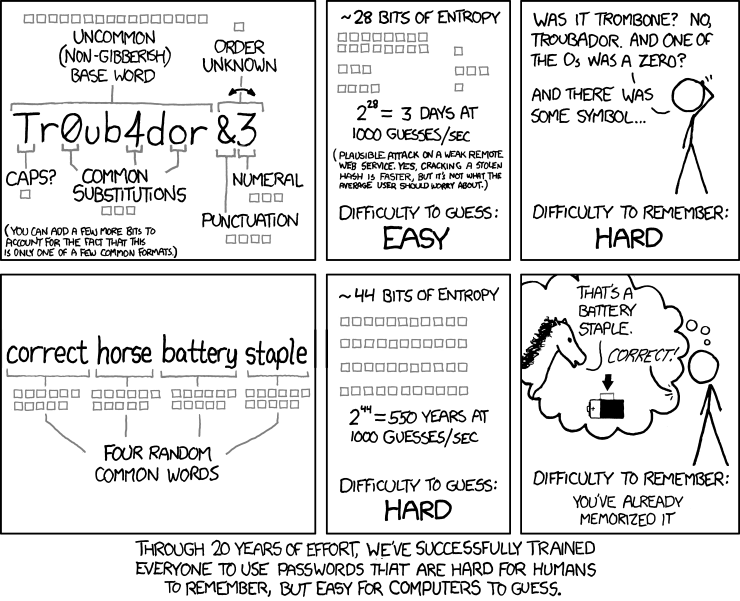
If you think you’ve got a pretty clever password that you use everywhere… First of all, that’s a major no no as once hackers crack it once they can apply the same password or variations to other sites you access. If you’re still not convinced check out this list of the 10,000 most common passwords to see if you’re on the list! A single high-end computer can test 100 billion passwords per second so random passwords that are used only on one site are key. However, if you’re not using a password manager, which you should, then you still don’ t need to make your password P@ssW0rd111!!!. The best way to make complex, hard to break passwords that are easy to use and remember is to string together multiple simple words. So, correcthorsebatterystaple is a great long complete password that’s formed from four easy to remember (and type) words and does the job better than that funky random one you’re been using. Hopefully, you’ve learned a little about password management and shared passwords that will make your life a bit more secure.



 10400 Connecticut Ave #411
Kensington, MD 20895
10400 Connecticut Ave #411
Kensington, MD 20895