AWS Cost Savings Ideas
Cloud hosting costs can spiral quickly, but you don’t need to be an expert to rein them in. By focusing on a few high-impact areas, you can dramatically reduce your hosting bill. Here we take a look at Amazon Web Services (AWS) hosting but these strategies are equally relevant with hosting on Microsoft Azure or other cloud hosting providers. Here are 5 proven strategies to start saving today!


Eliminate Unused Resources
One of the biggest (and easiest to fix) money drains is paying for resources you don’t use—like EC2 instances or RDS databases left running after testing. Think of it as leaving the lights on in an empty room.
Action: Regularly review your environment and shut down unused servers or databases. Even turning off a handful of test instances can save hundreds of dollars per month.
Manage and Clean Up Backups and Snapshots with AWS Backup Manager
Backups are essential, but unused snapshots and old backups often pile up unnoticed—quietly driving up costs.
Action: Use AWS Backup to automate retention policies. Define backup plans that keep what you need and automatically delete old recovery points. This keeps you protected without paying for unnecessary storage.


Right-Size Your Instances
Oversized instances are a common source of wasted spend. Running a powerful server when a smaller one would work is like renting a mansion when you only need an apartment.
Action: Use AWS Compute Optimizer for free, data-driven recommendations. For example, downsizing from db.r6g.xlarge to db.t4g.large could nearly cut your database costs in half—without impacting performance.
Leverage Savings Plans
For steady, long-term workloads, Compute Savings Plans can slash costs. By committing to a consistent hourly spend for one or three years, you’ll unlock discounts of up to 66% versus on-demand rates.
Action: Analyze your historical usage, set a stable baseline, and commit. Three-year plans usually deliver the deepest savings.


Set Budget Alerts
Mis-configurations or unexpected usage can cause bills to spike overnight. Budget alerts act as your early warning system.
Action: In the AWS Billing console, create an AWS Budget with thresholds (e.g., $500/month) and set alerts at 80% and 100%. If something unusual happens, you’ll know in time to fix it—before the bill arrives.
By consistently applying these five tactics—shutting down waste, managing backups, right-sizing, committing wisely, and monitoring spend—you’ll build a leaner, more cost-efficient AWS environment. If you need help putting any of this into practice don’t hesitate to Contact Us anytime for further guidance.
The Sales Process at Coretechs
I’m Gil Austin, the founder of Coretechs. This month I thought I’d go in depth on the sales process here at Coretechs. If you want to fill out our contact form, please do. If you want to get our pricing information, please do. However, if what you really want to do is get answers to your questions as rapidly as possible then Talk to Gil (Call Me) at 202-540-0002.

Talk to Gil: We have this plastered all over the website for a reason. It’s the single fastest way to get started. You get to provide as much information as possible about your current situation and how we can help. I’ll start listening immediately and won’t waste your time going through a formulaic approach with a lot of rote questions. Your challenges are unique and the hallmark of the custom software development experience is treating every situation on its own merits. On the phone we dive right into your needs and I can immediately assess what’s needed and how best to proceed.
Discuss Your Needs: This is NOT a high pressure sales process. If we’re going to be working together we need to be a good fit for your needs and each other. I have over 40 years of experience in the software development industry and my 30 person team of developers, designers and project managers are the best there is. We can dive right into the technical requirements for your project and I can offer immediate feedback on what might help.


Get Feedback and Estimate: Most of the time I can give you a fairly quick idea of what it’s going to take to bring your vision to reality. Here are some things that you might like to have ready for the call, if at all possible. If not, that’s fine too but the more information we have the easier it is to figure out next steps. Some things that are useful to know coming into our call are: urls of your current software, if any; language; frameworks; versions; repositories; hosting; access credentials; design requirements; wire-frames, etc. That’s a long list and you may not have any of it but if you’re considering your options with your existing team those are all good things to know regardless of where your next steps take you.
Finalize Contract & Retainer: The list of things we need to get you on board is pretty short; a contract and a small retainer. We have a short contract that we work with. Some people might describe it more like a master services agreement. It does not bind you to any long-term agreement. You own 100% of your system, your code, your site, your concept. If you decide at any time to find a new provider you own and manage the hosting account (typically at Amazon Web Services or Microsoft Azure) and have complete control of that environment. We want to make things as easy as possible for you now and in the future so we keep it simple and set you up for success.
Project Execution Begins: With a contract in hand we can get started as soon as you’re ready. We constantly have team members whose activity level changes and they’re ready to get started on something new. The basic team makeup on any new client engagement includes a project manager and a lead developer. In many cases, it may only be a small amount of time of each of these individuals. That all depends on the size and scope of your project. Your project manager will get to know all the ins and outs of your system. They will not only work with the lead developer to breathe life into your requirements but also make informed recommendations on possible future updates to increase your income and efficiency.
Your System Goes Live: We’re eager to get your MVP (minimally viable product) live asap. The sooner you go live the sooner you can start to build business, get feedback on the new site and get your team and customers using the new tools to make sales. We find this creates a virtuous cycle where your business becomes more efficient and you see the value in further investments in your technology. Truly a win-win for everyone!
White Labeling
If you have a great idea for a web-based business process or you have already built out a website for that process then White Labeling your software might be a good fit for you. White Labeled software can have different meanings depending on your relationship to the product. In this article we’re assuming that you own the original system and wish to market it to others. Let’s say that you have developed software for your dry cleaning business, “Bob’s Dry Cleaning”. You have three locations and all locations use the software. You tell your competitor who owns “Sally’s Dry Cleaning” about the software you’ve developed. They don’t have a comparable solution and would like to use your software. Even though they’re a competitor they’re willing to pay you a monthly fee to use your system. You decide this is a good idea and now you need a software development company like Coretechs to help you “White Label” your software.


We’ll work with you to update your software so that not only can you and your team login to manage your own business but also your competitor can login and manage their own business as well. Both of you would only see operations related to your own business even though you would be using the same software. The difference is, now it’s designed to be multi-tenant with complete anonymity and security for all users. With your first successful client on board you can now market your software to additional businesses within the dry cleaning industry and establish a potentially considerable monthly revenue stream.
White Labeling your software is not a new idea. In fact it is becoming more common. If you have a good product and can make it dynamic enough for others to use it, then you can set yourself up with a good business. We have helped customers create brand new white label solutions, upgrade and move existing white label products to new environments and have taken existing solutions and turned them into white label products. All of these paths come with unique challenges but here are some things our team has learned along the way.


Software solutions should have a specific function in mind. The software needs to satisfy a need for your customers. It does not need to fit every single industry. Find your niche and cater to that market. If you are taking an existing system and making it a white label solution, if at all possible have some potential customers ready to use your new system.
Be ready for scalability and growth costs. Once you get everything “perfect”, have a plan on how to support growth of data and usage. With the way information spreads today, it is very possible you could hit the jackpot in business and might need to support that demand. This includes your server costs, databases and other infrastructure. What do monthly costs look like? Can your hosting company scale quickly and efficiently to handle greater volume? Can you handle ten clients as easily as one?

More features means greater client retention and a broader audience. On Day one your clients will start requesting additional features. Those new features in turn will bring in more new clients and your business will grow. However, you should be “choosy” with what new functionality you want to add. Try to make sure it will have the broadest possible client appeal. Teaching your customers why the software is the way it is, how it was intended to be used and how they can make it work for them, will win you those long client relationships. Reach out to Coretechs and we can help and advise you every step of the way!
New or Existing?
When clients reach out to us for help with their web-based solutions it might seem that we’d always start from scratch. While that might make some things easier it’s actually the exception rather than the rule. Something like 85% of the projects we start working on are existing systems in various stages of development. While it might be more straightforward to start with a new website than to shepherd an inherited, partially completed effort all the way to completion we do it every day. Much like building a house the biggest challenges may come nearer the end than the beginning. That’s where that often lengthy punch-list comes into play of all the things that need to happen to wrap up. Here are a few of the situations we inherit when we try to get you over the finish line to Go Live!


In some cases, the client has worked with an offshore team or individual for initial development. Now that they’re getting closer to their anticipated ‘Go Live’ date they want to start working with a US based team to add the finishing touches, which can be considerable. They also want to ease any communication burdens and have their development team better align with their US based time zone. Another common situation is that the client started with a trusted family member or friend or had a single in-house developer. They may have worked with that person for many years but then something changes. They find a different job, retire or the needs of the site exceed their personal capabilities or their available development time.
Another regular occurrence is that one or more legacy systems require enhancements. If the system has been operational for a long time but not maintained there may not be anyone on client staff who understands how it works and/or has the requisite technical skills to make the needed updates. We’ve often dealt with sites that have not been updated in 5-10 years or more! At Coretechs we have deep cross-platform experience in so many web technologies (Python, .Net, PHP, Java, ColdFusion, native IOS and Android apps just to name a few) that we can help with almost anything that comes in. This multidisciplinary environment across so many technologies and so many of our team members allows us to deliver world class solutions from any starting point.


So, if you have an existing system that you think is not salvageable or the development resources you have are no longer able or available to move the project forward, please give us a call. And if you have a brand new project then that’s always a nice surprise! We have our own dedicated design team, project managers, front and back end developers so we can see your project from dream to reality whether you’re starting from the 21st century or the 90’s! As we like to say “If you can imagine it, we can build it!” Please visit our Contact Us Page and reach out for more information.
Integrated Services
Not surprisingly, many of the systems we develop don’t operate in a vacuum. Although it’s possible your inventory control system might not need to talk to any other resources, it’s unlikely. Hence the need for integrated services. One of the ones we work with most frequently is SendGrid. SendGrid is an SMTP mailer. There are of course competitors, but SendGrid has always stood us well. Many systems we develop need to send outbound email traffic to the management team and/or customers or other stakeholders. Although it’s possible to use your gmail account to send this traffic it’s problematic and subject to relay blocking and poor deliverability. With SendGrid you designate SendGrid as an authorized sender on your behalf using DNS entries. Then we use various SendGrid APIs to smoothly route any outbound email efficiently, with a strong reputation score and many tools to track deliverability and recipient engagement. To make all this happen we help to get you signed up with your own SendGrid account and then use API keys from within that account to send email automatically from within your system on your behalf.


Another feature that our clients often require is a payment processing portal. If your project plans to collect payments for items or services we’ll likely need to integrate your application with a payment processor. As with SMTP Mailers like SendGrid there are many alternatives such as Authorize.net and Sage. However, our preferred option, if the client doesn’t have a preference, is Stripe. Stripe offers a ton of features, detailed reporting and the ability to send incoming payments to multiple entities thus offering very sophisticated routing options for your funds. It’s easy to see what’s coming in and out each month, create monthly recurring payments and much more all through API communication that we integrate into your project.
If your system needs to store millions of documents (MS Word, PDFs, Excel docs, etc.) then you may need an integration to a document storage repository such as AWS S3. S3 storage containers provide low cost storage solutions for custom document storage and retrieval. We’ve helped create integrated API solutions for customers where they have terabytes of documents spanning a decade or more and need quick and easy retrieval to those documents within their system.


The above is just a taste of all the things to which we can connect your custom software development project. Most modern businesses expect and encourage you to interact with their platforms via automated Rest API traffic . They provide robust support and myriad APIs with which to do so. Then we help wire it all together. So, if you have a need to get data from A to B to C we can help you accomplish that task and do so every day. As we like to say “If you can imagine it, we can build it!” If you need more information please visit our Contact Us Page and reach out.
Laravel
Laravel can be a great framework for making things happen. At Coretechs, we have a deep bench in PHP. A lot of the people on the team have worked in it—in whole or in part—for their entire careers. Laravel has a full, mature, open-source content-management system, and can be used as a standalone framework or for integrating with Javascript on the frontend (whether Vue, React, Angular, or other frontend frameworks).
Coretechs writes new Laravel applications from scratch and also takes on many projects in Laravel which other teams originally developed. Given our experience, we like to advise clients about Laravel in a balanced way.
Reasons for Choosing Laravel
Laravel is a framework for building complex web applications with database integrations, APIs, and complex business logic in PHP. If the client or team is choosing to work in PHP and the project calls for a complex backend, Laravel can be the way to go.
- Security: Laravel releases new security patches on a regular basis to address common security issues. It is a dependable framework with a long-term track record, supported by an open source ecosystem and the support of legacy business and enterprise clients.
- Versatility: Laravel can be used to create almost anything, from content management tools and social networking platforms, to e-commerce sites. We often use it at Coretechs for building websites for eCommerce, health care, financial applications, and more.
- Approachable Syntax: PHP syntax is relatively easy to learn for developers, many of whom cut their teeth on much harder languages such as C/C++ or Java. Even for newer developers, Laravel has great tools and documentation for solving problems and getting things done.
- Active Development Community: Laravel has a large, active community. There are lots of great resources and tutorials available in it that make learning and developing with Laravel a good experience. Lots of major companies also build apps in Laravel , and that tends to drive long-term development and support of the core framework.
Developers’ Take
“Laravel makes it easy to build modern, secure, high-performance web applications. I have worked in it for years myself, and Coretechs has a great team for building and maintaining Laravel apps. It’s a particularly great way to build API-based applications for interfacing with Javascript, whether it’s React, Angular, or my own favorite frontend toolkit, Vue.JS.”

Arthur
Laravel /PHP Developer
“Laravel is easy to write. It has a CMS for working with PHP using the MVC pattern, and templating or building out api endpoints in Laravel is an easy and reliable process. Sometimes people build something out in custom PHP, and it is often harder to extend or maintain. Laravel has a very opinionated way of building an application though, which has its benefits.”

Vinod
Laravel /PHP Developer
“What’s great about developing in Laravel is that it has lots of libraries and documentation, and a great community. That makes it easy to get things done.”

Jonathan
Laravel /PHP Developer
Caveat Emptor: Buyer Beware
There are many reasons to choose Laravel as a framework, but we always try to give a balanced view. While Laravel has great libraries and support, it also has a very short release schedule. That means that there will be a fast pace for patching, or that a Laravel app can become unsupported very quickly if unmanaged. Also, while there are available admin panels for Laravel , it does not have one by default the way Python’s Django framework does. So here are some things to consider for anyone planning to spin up a new app in Laravel, or considering switching from a legacy Laravel application to a different framework.
- Short Release Schedule: Laravel does a new major version every two years, and offers only 18 months of bug fix support and two years of security support. That means two years after a major release, software written in Laravel is unsupported. This means owners of Laravel apps need to plan for a very regular schedule for patching and maintenance or deal with decreased security and compatibility as their app becomes unsupported.
- No Default Admin Panel: An admin panel is a handy way for clients, project managers, and non-developers to manage data and make new entries. It is often a great way to interact with an app’s data without having to get into the database or into the code. While there is an admin panel built and maintained by Laravel , it is not free or standard.
- Unmaintained Third Party Libraries: Third party libraries may have dependencies that go unsupported. When this happens, the process is opaque and they may fall out of support without sufficient warning, leaving a team scrambling to fix errors.
- Patching: Coretechs focuses heavily on keeping up with the latest patching schedule, but with Laravel expect to allocate more time to maintenace. It can be unclear whether Laravel updates are critical for security when compared with other frameworks such as .NET or Django.
Developers’ Take:
“Admin panels are great because they often make it easy for less technical people to add data to an app without having to interact with the database directly. Laravel does not have an admin panel by default, which would certainly make things easier.”
Arthur
Laravel /PHP Developer
“Laravel definitely has some downsides. The third party libraries often depend on each other, and when they go out of support or fail, it is not alway clear and can make patching and maintaining a complex app difficult. The short release and support cycle requires more maintenance.”
Vinod, Laravel/PHP Developer
Vinod
Laravel /PHP Developer
Our Greatest Hits (Volume 1)
We’ve been creating blog posts since back in 2021 and I think we’ve created a lot of useful content over the years. So, I thought it might be fun to go back over some of our greatest hits. If you’re too young to remember vinyl then you may want to check out this Wikipedia entry. So, off we go… I wanted to start with one I think may be quite valuable since you’re already reading our blog. Back in February 2022 we talked about Outsourced vs In-House Software Development and why you might choose one or the other. That can be super useful as you try to figure out the path forward for your development project. Of course you can always call me at 202 540 0002 anytime if you need further insight or want my personal take on your situation.


If you’re wondering what a project manager does, the answer is a lot! Check out Confessions of a Project Manager from October 2022 to find out how our amazing project managers create the magic against the background of never-ending requests. Our dedicated project managers are one of the key differentiators at Coretechs. Many software development houses harken more to the “Body Shop” model. They simply rent out developers and hope you’ll have enough insight to get value out of the developer. However, without a project manager in between who fully understands what you need and can turn that into “developer speak” to get it done quickly and efficiently that often goes awry.
On the other side of the fence, figuratively speaking, are our developers. Earlier this year we dug into that with Confessions of a Coretechs Developer. Our developers are, simply put, amazing! Unlike some traditional shops our developers work across multiple language environments. So, they might have Python/Django as their go to language but be quite comfortable working in PHP or Perl when the need arises. This comes up more often than you think as some of our clients have platforms as varied as Python, Grails, PHP and .Net, all under one roof, and need help managing and supporting that weighty blended environment.


Finally, I wanted to touch on our core mantra. How We Help Businesses Grow Through Custom Software from July 2023. This one digs into the true value you get from Custom Software. Most every industry has a few COTS (Commercial Off The Shelf) offerings that may provide an adequate solution for many businesses. Depending on the size of your company, the number of staff you have and the per seat pricing model this could be a good solution for you. However, if your needs stray from what’s available in a generic solution, you want to fully own your system and you know what’s needed to revolutionize your industry then, if you can imagine it, we can build it! If you need more information please visit our Contact Us Page and reach out. I hope you’ve enjoyed this stroll down memory lane. See you next month, same bat-time, same bat-channel!
Coretechs Logo Evolution
Logos are something that can be deeply personal. When I started Coretechs back in 1986 I had to come up with both a company name and a logo. I came up with Coretechs for the name since it sounded “techie” and was a good fit for both software development and IT support services. At the time I decided that it should be capitalized both on the “Core” and the “Techs” so it came out as CoreTechs. Generally, automated systems and word processors don’t like capital letters in the middle of words, so eventually that became Coretechs. If you’re thinking of coming up with a name for your business you may want to consider avoiding being too “cute”. Coretechs can sometimes be spelled by clients as Cortex, along with many other misspellings, which is probably part of it’s derivation but makes it challenging when you’re trying to pass on your website url! Sometimes I wonder if I should have just gone with “AAA Consulting” 😉
With the name in hand now I needed a logo. I hired a consultant for the original logo. They came up with a variety of suggestions and I finally settled on the world wrapping CT combo. I thought this was a pretty strong logo and I liked the color scheme. I’m a big fan of red! Once I had the business name and the logo (and a big stack of incorporation documents, tax forms, etc) we were ready to go.
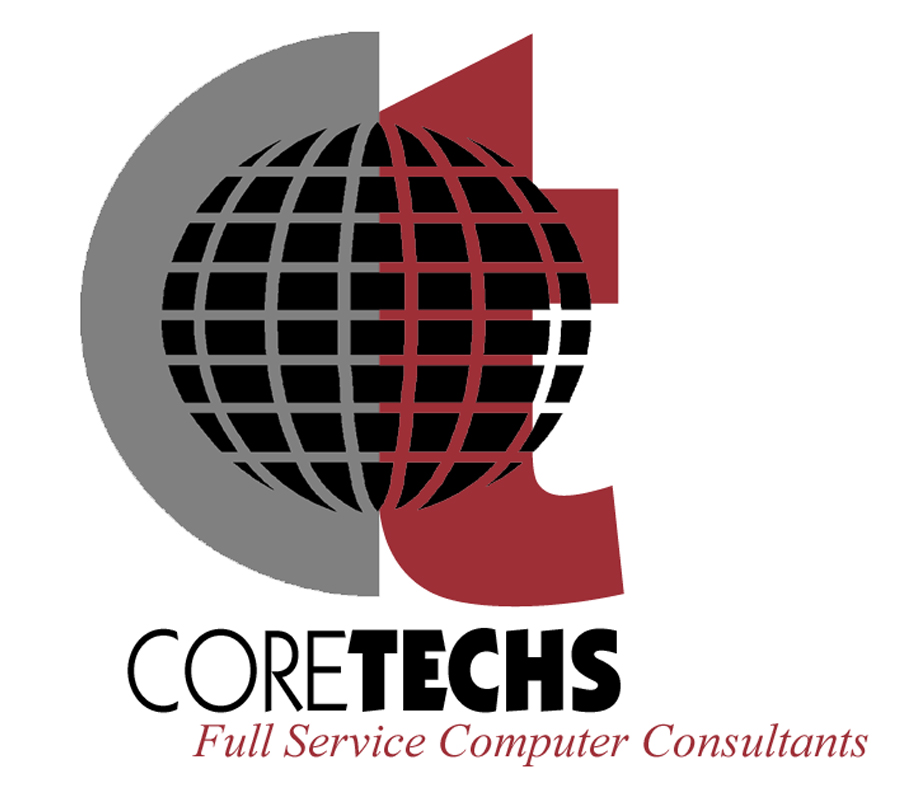

I liked the original logo but there was always the challenge of where to put the company name. Should it go to the right of the logo, below the logo or somewhere else entirely. Also, I had to decide whether to use “Coretechs” or the longer version “Coretechs Consulting, Inc.”. Also, if you’re not AT&T you may struggle with brand recognition. AT&T can get away with a picture of the globe and some blue lines. However, those of us with a slightly smaller business have to make sure the company name always appears with the logo hence the location issues.
So, after many years of considering my options I worked with a client of mine to tighten up the coloring and worked to incorporate the business name with the logo. This dealt with the name issue external to the image and was a step in the right direction. However, the font size on the logo was not quite large enough to stand out as a readable element and it didn’t work well where you didn’t have a lot of space.


So, back to the drawing board for the next iteration. I didn’t know exactly what it would look like but I took the latest version to a former staff member to try and get over this last challenge. They were able to make the leap to the idea that the business name could be slightly larger than the base logo and hence provide enough space for the business name that it was easily readable in any situation Additionally, they added some slight customization around the name, left and right, that enhanced the original logo while still adding the new information I was looking for. This really popped!
So, with a final version in hand that met all the original objectives from almost 40 years ago I thought it would be fun to show that transition over the years. I reached out to Hariz, one of our great designers and developers, and asked him to create an animation showing the evolution of the logo over the years. The idea was to model this on the NBC Peacock logo transitions which you may have seen. Even though he hadn’t really done any animation work before he was able to come up with a great animation. That’s one of the hallmarks of the amazing team at Coretechs. They’re not afraid to leap into anything to get the job done! So, here’s the final version showing the changes over time. Enjoy!
Why We Love Our Developers
Here at Coretechs, we are a tight-knit team that works together to bring your project to life. We would not be able to do what we do without our amazing developers. Here are some reasons why we love them and could not do what we do without them.
Our developers are the best and here’s why!
While we tend to say that we’ve been around for over 35 years and that is primarily due to our clients, we would be nothing if not for the developers who work around the clock to keep your software systems up and running. They can juggle multiple projects with ease, delve into issues head first, and give us and you ideas about how we can constantly improve your system.
They are willing to learn new technologies and strategies.
Many industries are the type where specialized training or study is required before the job is performed. Here we are always doing a little bit of “on the job training” when we ask our developers to learn a new technology or language. At this point, it becomes more like an art than a science. Our developers are commonly implementing new third-party features that require some research and understanding to do work. This is a skill that we ask of all our developers, and they rise to the challenge.
They are problem-solvers and have a can-do attitude.
Every single one of our developers is solving problems in their work. We are not just blindly coding something with copy/paste. These developers are thinking through logic and issues and providing real-life solutions that are used by our customers every day.
If we do not understand the problem, we go back for further investigation to find a better solution. If that solution is a temporary “band-aid,” we are coming up with a backup plan that can be implemented long term. The point here is that our developers are creative problem solvers, and we love them for that!
They are willing and able to adapt.
All of our clients have different setups. Understanding how someone else designed and implemented a setup can be a big ask. But our developers do it with a “can-do attitude.”
Not only do the developers learn the various setups, but they are flexible to jump from system to system within a short time to put out any fires. If we have an urgent issue, our developers can quickly put down what they are working on to pitch in and help with whatever the problem is.
They genuinely care about their projects and our client’s success.
Our developers have direct access to speak with the clients. We do this because we want you to know the developer working on your project, and we want them to know you. The developers care about helping our clients grow their business and provide solutions for them that will work and contribute to their success. If our developers can listen to you, talk about your business, and what is needed, they can put themselves directly in your shoes when they are creating it and therefore provide you what you want. They want to know your business better.
They are dedicated to the team environment.
Our developers do have individually assigned projects and smaller tasks; however, there are many times one cannot get back to a project for a conflict. That is when the teamwork kicks in, and our developers step up to the plate to pitch in. That sometimes looks like passing on the torch to finish out a project or just stepping in for a day. It also means teaming up to bounce ideas off one another. We form many different team combinations throughout the day at Coretechs, and dedication to working together is a key ingredient to our success for you.
“Our development team is one of the first groups of co-workers I talk to outside of work hours. They are friendly, knowledgeable, personable, and bring their own ideas to projects, more than just building what is written on a project plan in front of them.”
Jon A., Project Manager
Custom Software Development
What’s special about custom software?
Custom software development is the creation of software built precisely for your company and personalized to meet the specific demands of your business. It can grow with your business and sometimes even power that growth.
Eventually, you’d likely see more customer engagement, enhancement of your processes, and opportunities to better understand your full potential. We make custom websites and apps to adapt to and meet the needs of your business. Conversely, “off the shelf” software requires your company to adapt to its abilities.
Some advantages of custom software:
- You only pay for the functionalities and capabilities your business actually needs and will actively use. Packaged software tends to have a lot of features that are unnecessary and are rarely or never used.
- Custom software helps automate a lot of your business processes by reducing tedious tasks for your employees. In the long run, this lowers the risk of human error and allows them more time for projects with higher meaning or importance.
- During the process of building custom software, you may discover opportunities to optimize your operations. Finding these possibilities will ultimately lead to higher productivity for your company.
- Packaged software is readily available, but it cannot be tailored to meet your business’s distinct needs. Custom software fills in the gaps to suit your needs that packaged software can’t. You can have many different unique features and integrations made for your business and its processes.
Some things to consider:
- Building custom software from the ground up can be a lengthy process and takes more time than buying something pre-built and packaged.
- Custom software is an investment and generally costs more initially than “off the shelf” software. However, the return on investment is higher than that of packaged software. Custom software typically has a higher ROI because we tailor it to meet your specific business goals.
Our Custom Software Development Process
As a custom software company, our number one goal is to create unique and effective software solutions for our clients and deliver them on time and within budget.
Our proven approach:
- We put a dedicated project manager on every client’s project. This way, there’s a single point of contact throughout the development process.
- Our project managers and developers will listen to what’s needed and make it happen. They’ll keep you updated during the entire process, from the first contact to production.
- Our team will even let you know when there may be an alternative approach that can create even better results. We always make any web application’s longevity, scalability, and security a priority and inform you of changes we think will improve your software’s performance.
- Our rapid prototyping process lets you see your project as it grows from concept to reality. We’ll also keep you in the loop at all times, and we take every concern or request into account.
- Finally, after the development process is complete, we offer monthly maintenance and security checks. We make a point of only charging for the time we work on these checks and do not implement a monthly maintenance fee.
Many of our clients have been working with us for 10 or 20 years to refine their custom software needs as their businesses develop and grow. If we can help you create your vision or update your current software, contact us today!


 10400 Connecticut Ave #411
Kensington, MD 20895
10400 Connecticut Ave #411
Kensington, MD 20895